One place for AI to talk to your business
An Onyx alternative
you don't have to host yourself
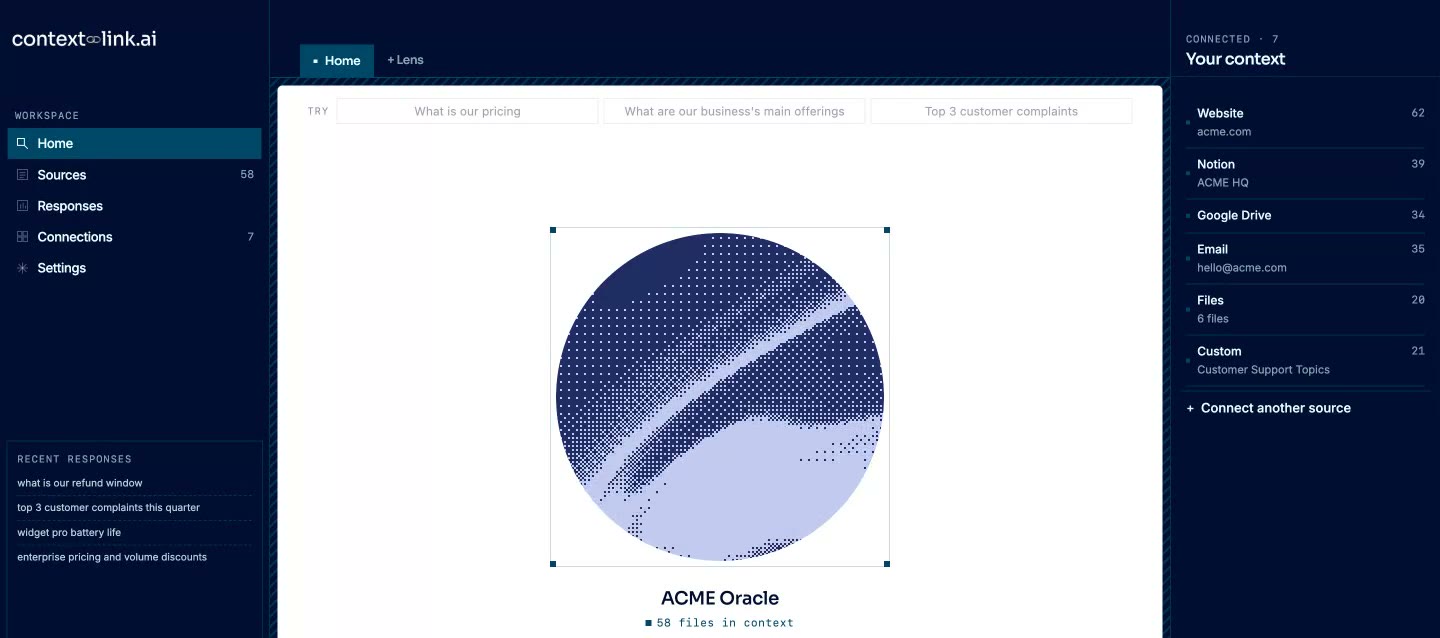
Onyx is open-source enterprise search you deploy on your own infrastructure: Docker, Vespa, PostgreSQL, Redis, and your own LLM keys. Context Link is fully managed: one place for AI to talk to your business. Connect your sources, ask source-backed questions from inside ChatGPT, Claude, Gemini, or any MCP-aware agent, and save settled decisions as Memories. Sources sync every 24 hours, and every answer comes back with citations. No servers, no DevOps, no infrastructure to babysit.
7-day free trial · start for free · cancel any time
Comparing
 vs
vs

01 / At a glance
Key differences
Onyx is self-hosted enterprise search that needs Docker, 12+ CPU cores, 24 GB RAM, and ongoing DevOps to maintain
Context Link is a fully managed knowledge base for AI: Connect, Ask, Remember. No servers, no containers, no infrastructure to break at 2 a.m.
Onyx stops at search inside its own chat UI. Context Link answers with citations inside the AI tools your team already uses, and lets AI save knowledge back as Memories
Every answer is source-backed with citations, and sources sync every 24 hours
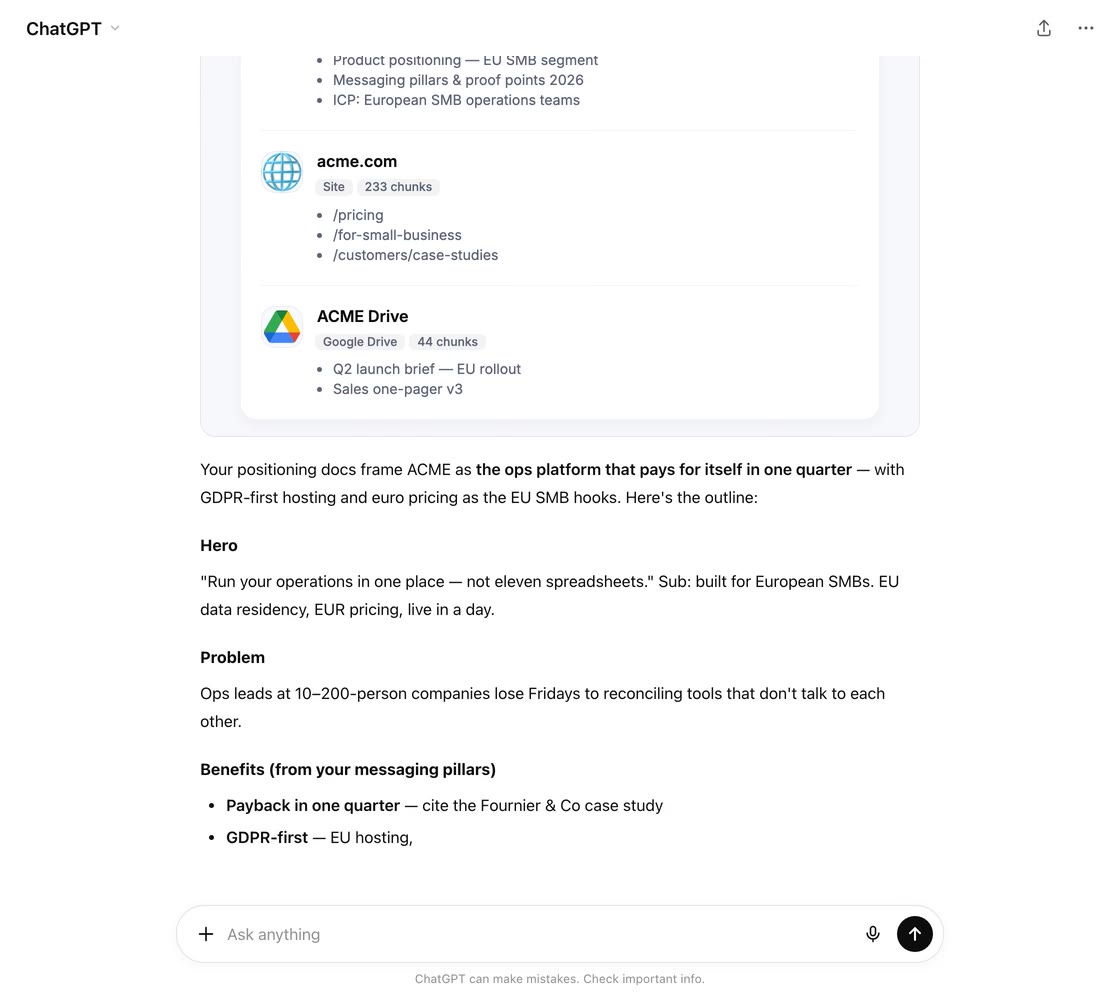
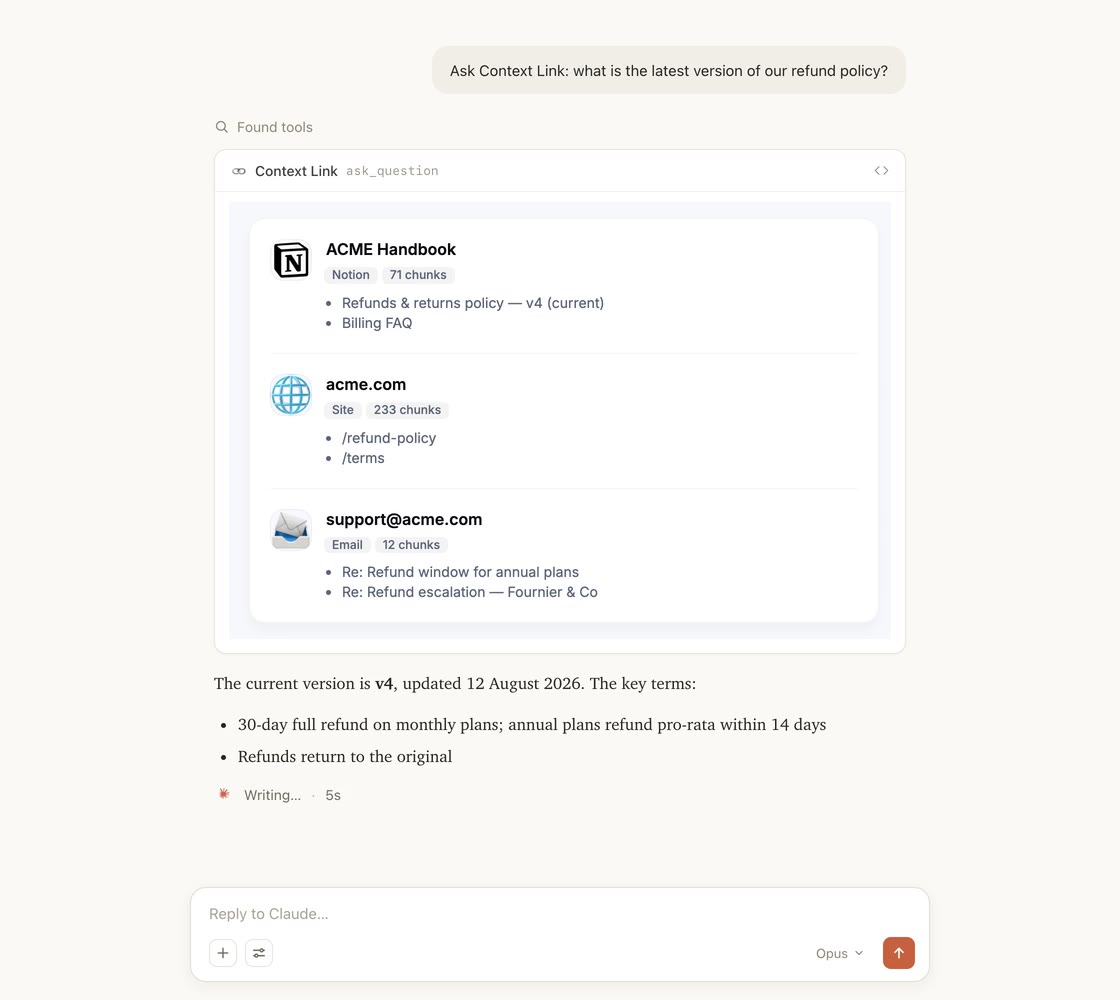
Reach Context Link from inside ChatGPT, Claude, Gemini, and any MCP-aware agent. Onyx asks your team to log into its own chat UI
Onyx requires you to bring your own LLM API keys. Context Link bundles retrieval and answer composition into the service
02 / No new tools
Use your existing AI
 · ChatGPT
 · Claude
Your sources
With your existing knowledge sources



 Basecamp




03 / Decision time
Which Should You Choose?
Onyx and Context Link both give AI access to your company knowledge. They take fundamentally different approaches to getting there.

Choose Onyx If...
- You have a developer or DevOps engineer who can deploy and maintain a multi-container Docker stack
- Data sovereignty is non-negotiable: you need everything on your own servers, no exceptions
- You want to customize the search pipeline, fork the code, or build on top of the platform
- You need enterprise connectors like Salesforce, Jira, Confluence, or ServiceNow
- You're comfortable managing LLM API keys, model servers, and infrastructure costs separately

Choose Context Link If...
- You're a founder or owner-operator running a small business of 3-200 that uses AI every day and doesn't have DevOps capacity
- You want source-backed answers with citations, from across Notion, Docs, email, and your website at once
- You want to save settled decisions as Memories that every connected AI reads the latest version of
- You want AI to reach Context Link from inside ChatGPT, Claude, Gemini, or any MCP-aware agent, with no new chat surface to adopt
- You need to connect Notion, Google Docs, Google Drive, email (Gmail, Outlook, Zoho, Fastmail, IMAP), Basecamp, Monday.com, websites, or uploaded files
- You want to be set up today, not after a week of Docker troubleshooting
04 / Side by side
Feature comparison
| Capability |
Onyx
|
Context Link
|
|---|---|---|
| Where you work | Onyx's own chat UI (or Slack integration) | From inside ChatGPT, Claude, Gemini, and any MCP-aware agent, plus a dashboard for humans connecting sources, reviewing responses, and managing Memories |
| Core promise | Self-hosted enterprise search over your connected sources | One place for AI to talk to your whole business: connect sources, ask source-backed questions, save Memories. Fully managed |
| AI model | Bring your own. OpenAI, Anthropic, or self-hosted, you manage API keys and costs | Model-agnostic on the asking side. Retrieval and answer composition are bundled into the service |
| Connectors | 48 connectors, enterprise-focused (Confluence, Jira, Salesforce, Slack, Google Drive, etc.) | Notion, Google Docs, Google Drive, email (Gmail, Outlook, Zoho, Fastmail, IMAP), Basecamp, Monday.com, any website, uploaded files (PDFs, Word, Markdown), plus custom connections (your AI pushes data from any service it can reach) |
| Setup time | Hours to days (Docker deployment, OAuth config, LLM setup, infrastructure provisioning) | Minutes (self-serve, no IT needed) |
| Pricing | Free self-hosted (but you pay for infrastructure ~$150+/mo + LLM API costs) or $20/user/mo cloud + LLM costs | SMB-friendly per-seat pricing, all-inclusive, no hidden infrastructure costs |
| Team size | Built for enterprise teams with IT support | Built for founders and small businesses of 3-200 |
| Memories (save the latest truth) | No equivalent. Onyx is read-only search over existing documents | AI and humans save settled decisions as Memories: named, canonical docs with version history, so every connected AI reads the latest version |
| Kept in sync | Onyx searches what you've indexed | Sources sync every 24 hours across Notion, Docs, email, websites, and files, so AI reads what your business says today |
| Direct question answering (Q&A) | Onyx Q&A inside Onyx's web app / Slack bot | Ask Question skill invoked from inside ChatGPT or Claude: `/ask-question [question]` or "ask Context Link what …". Returns one grounded paragraph with numbered citations. Secondary to the primary `get context on [topic]` workflow |
| Best for | Teams with DevOps capacity who need full control over their search infrastructure | Giving your business one connected knowledge base every AI tool can ask, without running servers |
05 / Two approaches
The Real Differentiation
Onyx
Onyx is a genuine open-source RAG platform with serious engineering behind it. It connects to 48 enterprise tools, supports any LLM, and gives you full control over your data. But 'full control' comes with real costs: you need Docker, PostgreSQL, Vespa, Redis, model servers, and someone to keep it all running. The baseline deployment needs 12 CPU cores and 24 GB of RAM. Users have reported Vespa consuming 42 GB on a 64 GB machine. And once you've stood it up, the product is still essentially a search box: it indexes your sources and lets you query them, inside its own chat UI. There's no way for AI to save knowledge back.
Context Link
Context Link is one place for AI to talk to your business, fully managed. Connect the places work happens (Notion, Google Docs, Google Drive, email, Basecamp, Monday.com, websites, uploaded files) and Context Link keeps them in sync as one connected knowledge base. Ask source-backed questions from inside ChatGPT, Claude, Gemini, or any MCP-aware agent, and every answer comes back with citations. Save settled decisions as Memories, and every connected AI reads the latest version. Under the hood it works like an AI knowledge base and managed RAG workspace, with sources synced every 24 hours, and you don't have to run any of it.
Onyx gives you a search box and infrastructure to run. Context Link gives AI one place to talk to your business, fully managed.
06 / No new tools
Meet your team where they already work
Your team stays on the best AI tools for them — ChatGPT, Claude, Gemini, Copilot. Context Link upgrades every conversation with your company's actual knowledge. Easy adoption, zero workflow disruption.
Your team's AIs
ChatGPT
Claude

agent 004
session
One connected knowledge base




 +
+
+
+
+
+
07 / Their strengths
What Onyx Does Well
Onyx is a real product built by a strong team (YC W24, backed by Khosla Ventures and First Round Capital, used by Netflix and Ramp). If you have the infrastructure capacity, these strengths genuinely matter.
Genuinely open source
The Community Edition is MIT-licensed. You can read every line of code, fork it, modify it, and run it entirely on your own servers. For teams with strict open-source requirements or regulatory constraints, this transparency is valuable.
Full data sovereignty
Self-hosted means your data never leaves your infrastructure. For defense contractors, financial services, healthcare, or anyone with strict data residency requirements, this is a real differentiator.
Model agnostic
Onyx works with OpenAI, Anthropic, Google, or self-hosted models via Ollama and vLLM. No vendor lock-in on the AI model layer: you pick what works for your use case and budget.
48 enterprise connectors
Confluence, Jira, Salesforce, Slack, Google Drive, SharePoint, Zendesk, HubSpot, and many more. If your knowledge lives in enterprise tools, Onyx probably has a connector for it.
Permission-aware search
Onyx inherits access controls from your source systems. Users only see documents they're authorized to see, important for organisations where not everyone should access everything.
08 / Our strengths
What Context Link Does Differently
One connected knowledge base, not just a search box
Onyx indexes and retrieves inside its own chat UI. Context Link connects your sources, keeps them in sync every 24 hours, and answers with citations inside the AI tools your team already uses.
Memories, save the latest truth
AI and humans can save settled decisions as Memories: named, canonical documents like a positioning statement or a pricing rationale. Update a Memory and every connected AI reads the latest version, with history kept. Onyx is read-only search; Memories let AI write knowledge back.
Always in sync
Sources sync every 24 hours, so AI reads what your business says today, not a snapshot from the month you set it up. No manual refresh, no stale index.
Returned with citations
Every answer cites the exact sources it came from, past lookups are reviewable in the responses log, and anything you don't want indexed can be excluded with a click.
No infrastructure to manage
Context Link is fully managed. No Docker, no Vespa, no PostgreSQL, no Redis, no model servers. Indexing, chunking, embeddings, and retrieval are all handled for you.
Reach Context Link from inside the AI you already use
Ask from inside ChatGPT, Claude, Gemini, or any MCP-aware agent. Onyx asks your team to log into its own chat UI. Context Link plugs into the tools they're already in.
Connect the sources small businesses actually use
Notion, Google Docs, Google Drive, email (Gmail, Outlook, Zoho, Fastmail, custom domains via IMAP), Basecamp, Monday.com, any website via sitemap, uploaded files (PDFs, Word docs, Markdown). Onyx's connectors skew enterprise (Confluence, Jira, Salesforce). Context Link connects to the tools small businesses run on.
Minutes to value
Connect your sources and start retrieving context the same day. No Docker troubleshooting, no OAuth configuration debugging, no waiting for Vespa to finish indexing. One person can set this up on a Tuesday afternoon.
SMB-friendly pricing
Built for founders and small businesses of 3-200. No infrastructure costs to estimate, no LLM API bills to track separately, no 'free but actually $150/month in cloud compute' surprises.
09 / FAQ
Frequently asked questions
Is Context Link a direct replacement for Onyx?
Onyx is free and open source. Why would I pay for Context Link?
What about Onyx's cloud plan at $20/user/month?
What are Memories?
How does Context Link stay current?
How do I know where an answer came from?
Can I use Context Link with ChatGPT AND Claude?
Onyx has 48 connectors. Does Context Link have enough?
How long does it take to set up?
What about data sovereignty? Onyx lets me keep data on my own servers.
I am looking at Onyx to build retrieval into my own product. Is Context Link an option for that?
Does Context Link have an 'Ask' feature like Onyx?
10 / Summary
The bottom line
Onyx
Onyx is a serious open-source RAG platform backed by YC, Khosla Ventures, and First Round Capital. If you have a developer who can manage Docker deployments, need full data sovereignty, or want to customize the search pipeline at the code level, Onyx gives you that control.
Context Link
Context Link is one place for AI to talk to your business, fully managed. Connect your sources once, ask source-backed questions from inside ChatGPT, Claude, or any MCP-aware agent, and save settled decisions as Memories. Sources sync every 24 hours and every answer comes back with citations. No servers, no API keys, no infrastructure to babysit.
Quick decision guide
Your pain
I need full data sovereignty and the ability to customize the RAG pipeline at the code level
Solution
Onyx is the right choice
Your pain
I want AI grounded in my business, with citations on every answer, without running infrastructure
Solution
Context Link is the right choice
Your pain
I want a managed knowledge base that stays in sync and lets AI save knowledge back, not just enterprise search
Solution
Context Link is the right choice
Your pain
I don't have a developer to maintain Docker containers, Vespa, and model servers
Solution
Context Link is the right choice
Get started
Give AI a Way to Talk to Your Business
No credit card required. No servers to provision. No Docker needed.
7-day free trial · start for free · cancel any time
11 / Pricing
Pricing
7-day free trial · start for free · cancel any time
Context for business
7-day free trial
includes
start for free · cancel any time
Developer API
7-day free trial
includes
start for free · cancel any time

Supported by real humans
12 / More comparisons