Works with Claude, ChatGPT, Copilot, and Gemini
Context Engineering Made Practical
The context engineering tool for small teams. Connect your docs, email, and sites once, then ask source-backed questions from inside the AI you already use. Every answer cites the sources it came from.
7-day free trial · start for free · cancel any time
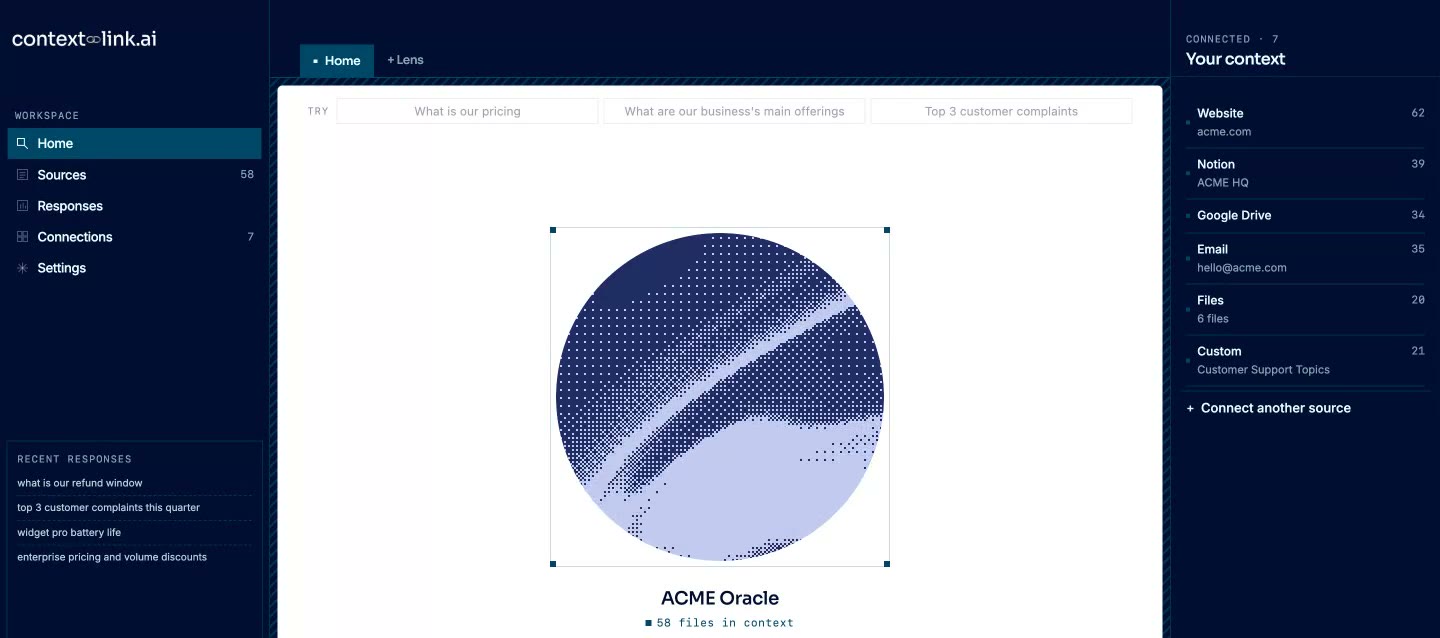
01 / Why Context Link

Skip the DIY
RAG stack
No embeddings pipelines, no vector DB to maintain. Connect your sources and Context Link handles chunking, retrieval, and formatting.

Search every source,
not one at a time
Ask once, pull from Notion, Google Docs, email, Basecamp, Monday.com, your site, and custom connections. No guessing which tool holds the answer.

Context Link remembers,
so you don't have to
Stop tracking where context lives: every connected source is searched together, by meaning. Save settled decisions as Memories, and every AI tool reads the latest version.
02 / Works with







 Basecamp


 Custom
 Websites
 Files
Files
 Email
Email
 Memory
*Don't see a pre-built connection? Download the custom-connections skill and Claude builds it for you. If Claude can read it, you can push it to Context Link.
03 / What it does
Context engineering without the stack
Most context engineering tools ask you to build your own pipeline. Context Link is a managed service: connect Notion, Google Docs, OneDrive, Basecamp, Monday.com, email, websites, or uploaded files, and the retrieval layer is ready in minutes. And if a tool isn't in the catalogue, the custom-connections skill lets your AI build the connection itself. If Claude can read it, you can push it to Context Link.
Semantic retrieval, not keyword match
Ask for context on a topic and Context Link returns the most relevant snippets by meaning. Get context on 'refund process' and it finds the paragraphs even if your docs say 'returns policy'.
Model-agnostic, runs inside your AI
Context Link works inside Claude, ChatGPT, Copilot, and Gemini via skill, connector, or direct link. One setup, every model. No lock-in to a single provider's plugin system.
Always in sync, returned with citations
Most context engineering tools stop at retrieval. Context Link syncs your sources every 24 hours and makes every answer traceable: exact sources cited, past lookups reviewable, and anything you don't want indexed excluded with a click.
04 / In action
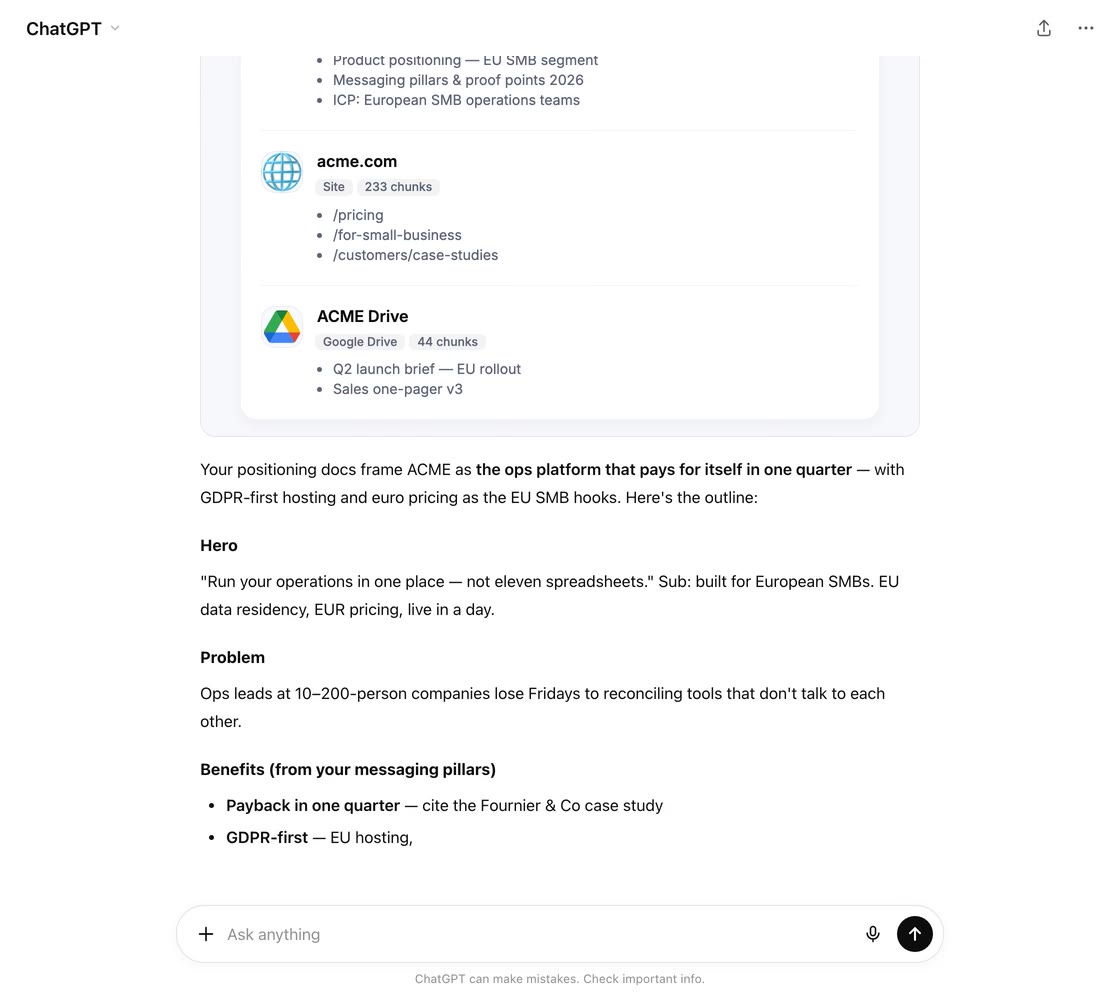
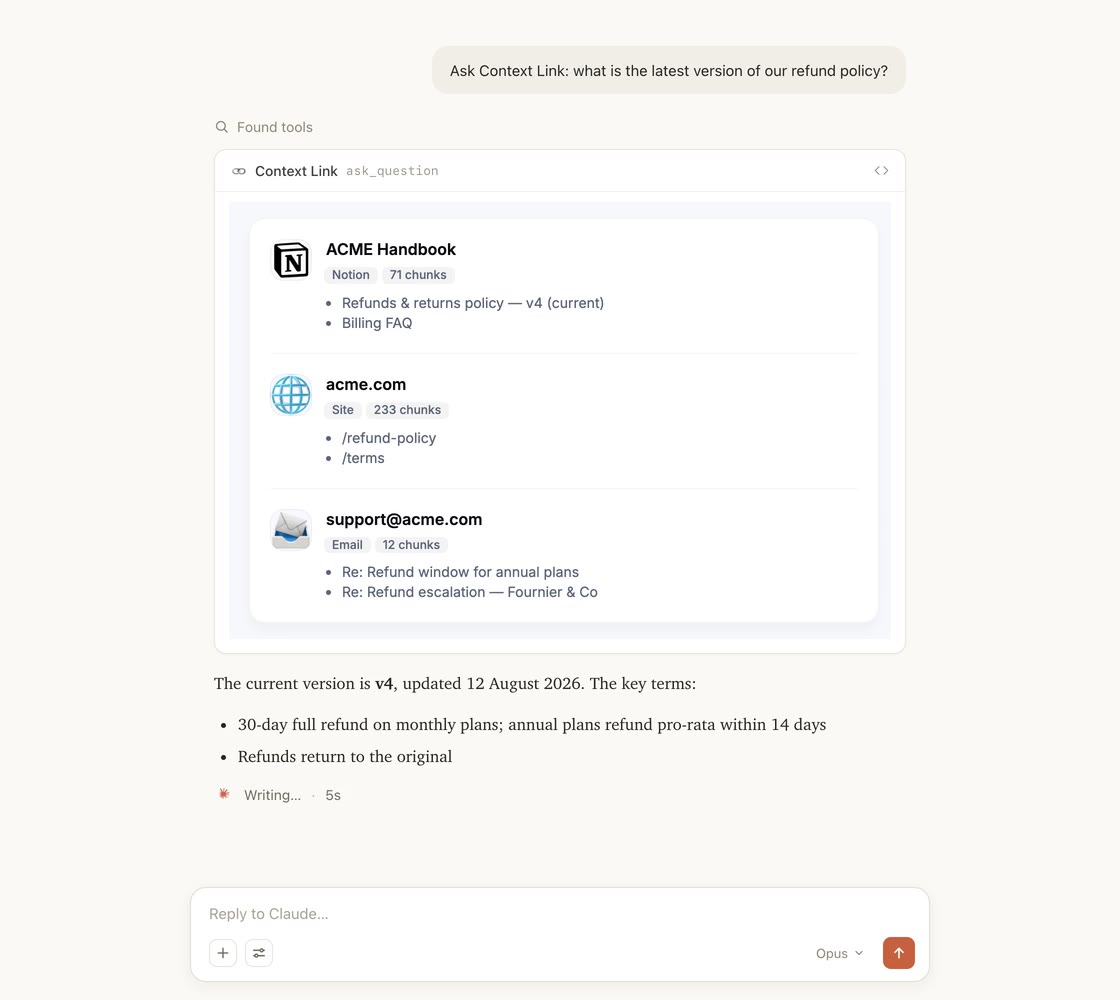
Integrates with the AI you already use
Available in every chat and project of the AI you already use. Complete with unified search across all your connections.
05 / Tools & skills
Skills your AI already knows how to call
Install once and your AI gets a vocabulary for your business: pull source-backed context, ask for a cited answer, or save a decision every other AI tool will read next time.
Tools & skills
Available in ChatGPT, Claude, Claude Code, and any MCP-aware agent.
Pulls source-backed context on a topic into the AI's working context.
When: “get context on…”
One concise answer with citations, grounded in your sources.
When: “ask my docs…”
Distills the conversation into a reference doc and saves it.
When: “save this as…”
Fetches a saved memory, merges in what's new, saves it back.
When: “update… with…”
The AI becomes the fetcher: pushes any service's data into your knowledge base.
When: building a custom source
06 / Industries
Context Link works with your kind of business.
Whatever you run, it probably lives in a variety of places. Connect them once, and Give AI a single way to talk to all of it.

Connect the support inbox, brand book, catalogue and help centre once, and AI gets a single place to ask your whole e-commerce business. From ChatGPT or Claude, ask what customers keep contacting support about, what you currently say about pricing, or how a product is described, and get source-backed answers instead of pasted-in context. When you settle something, like a returns policy or a brand rule, save it as a Memory so every AI tool reads the latest version.

Connect the docs you already keep, like specs, changelogs, interviews and support threads, and stop rebuilding that context in every AI tool. From inside ChatGPT or Claude, ask about your positioning, a past decision, or what users actually said in interviews, and get source-backed answers without knowing which doc holds them. Then save the canonical stuff, like your ICP or pricing rationale, as Memories that stay current as they change.
Connect your back-catalogue of briefs, case studies, brand books and project archives, and give AI one place to ask the whole studio. Ask anything and get source-backed answers grounded in your real history, so strategy stops half-remembering and starts citing, and every pitch stands on work you've actually done. Save the things you keep re-explaining, like your process or your point of view, as Memories any AI can pull into the next deck.

Your business lives in a variety of places, like docs, sites, inboxes and files. Connect them once and Context Link becomes the single place ChatGPT, Claude and agents can ask across all of it, returning source-backed answers without you guessing where the answer lives or pasting in background. Your business stops being something you re-explain to every AI tool, and becomes something they can simply talk to.
08 / Workflows
Workflow
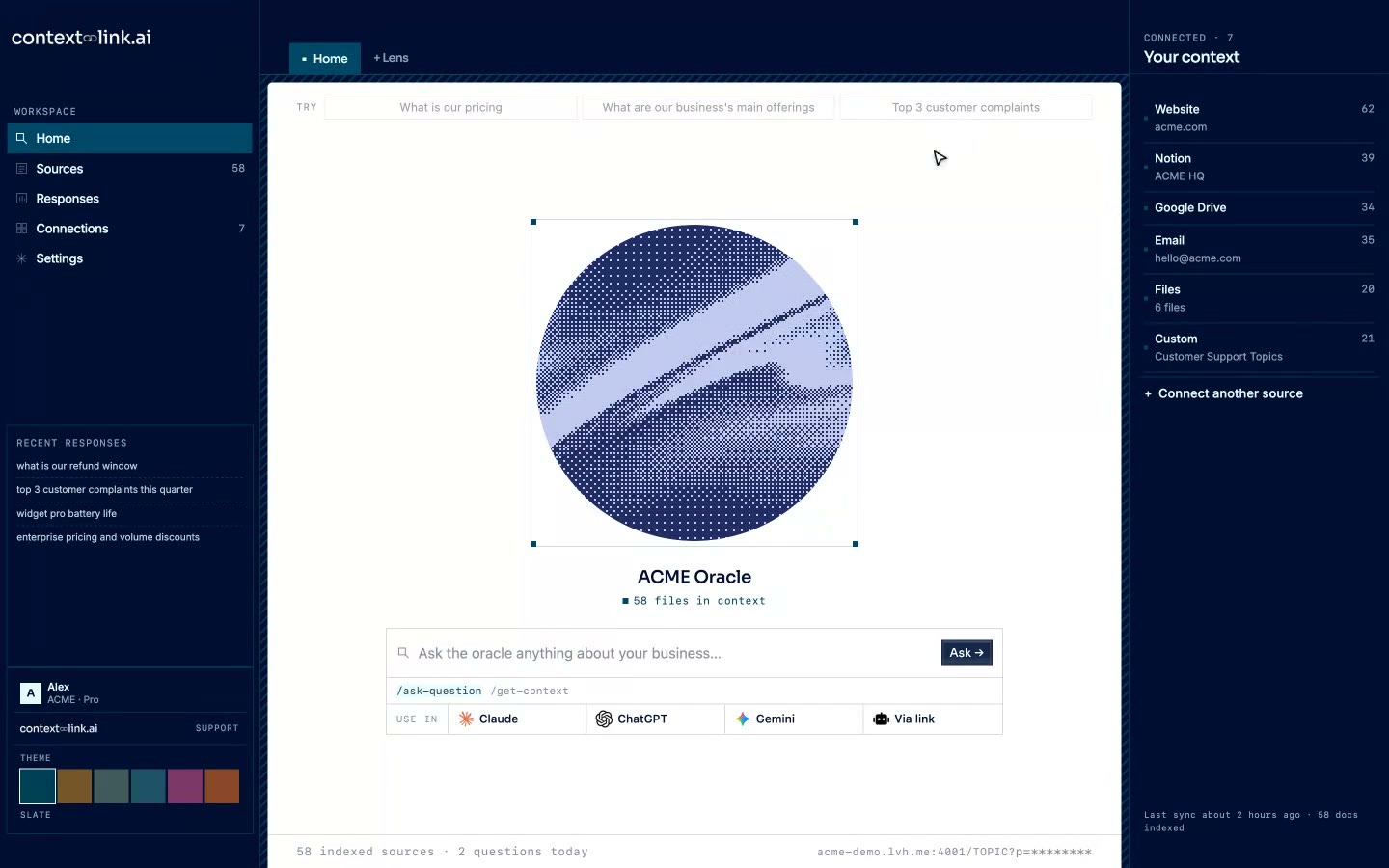
See exactly what AI used and improve over time
Every response is logged: which sources were pulled, what was returned, and when. Review quality, spot gaps in your content, and re-sync when something's outdated.
Workflow
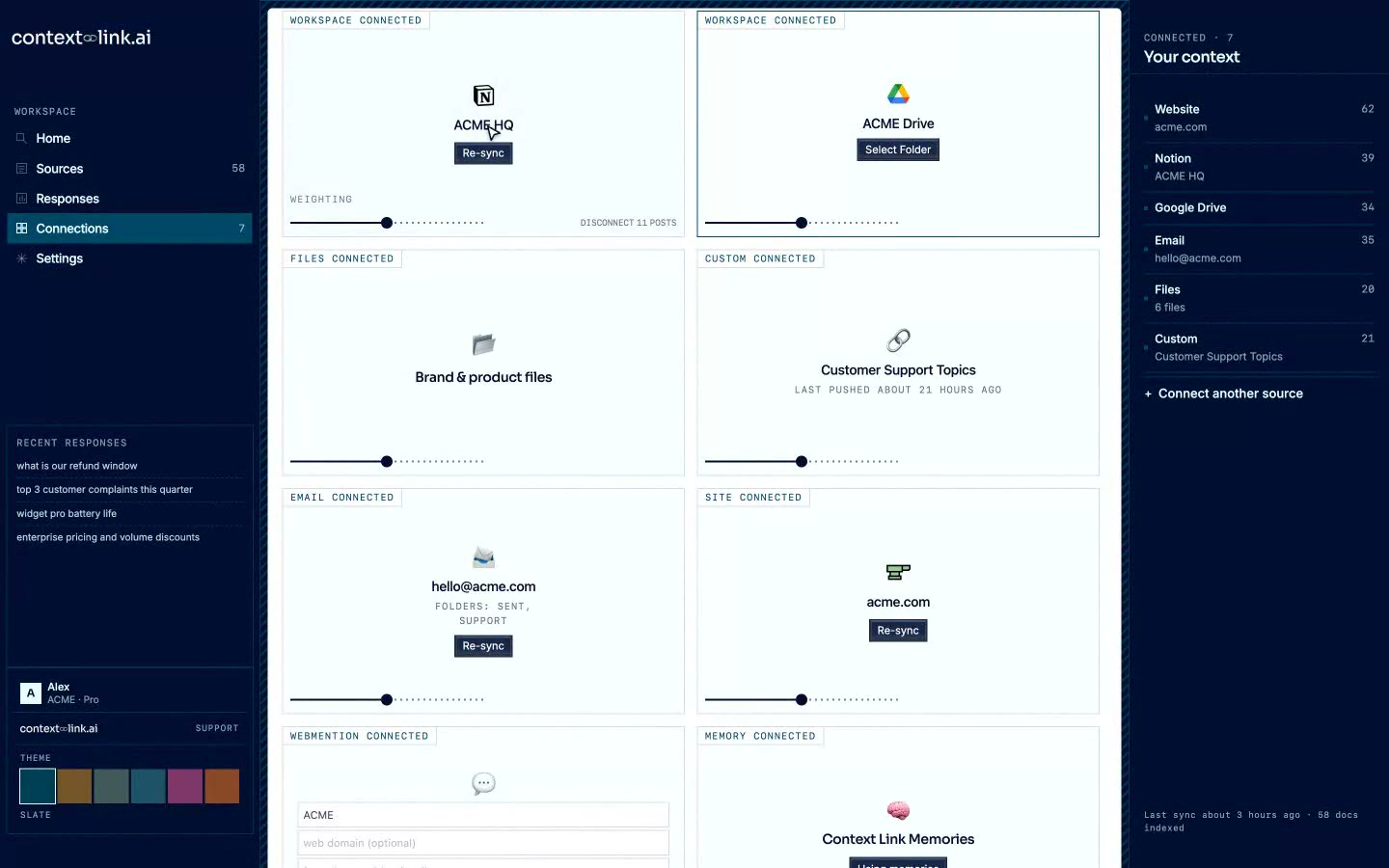
You control what AI knows nothing more, nothing less
Choose exactly which Notion pages, Google Docs, folders, and site sections to include. Add, remove, or re-sync sources anytime. Your AI only sees what you've approved.
Tune context per use case
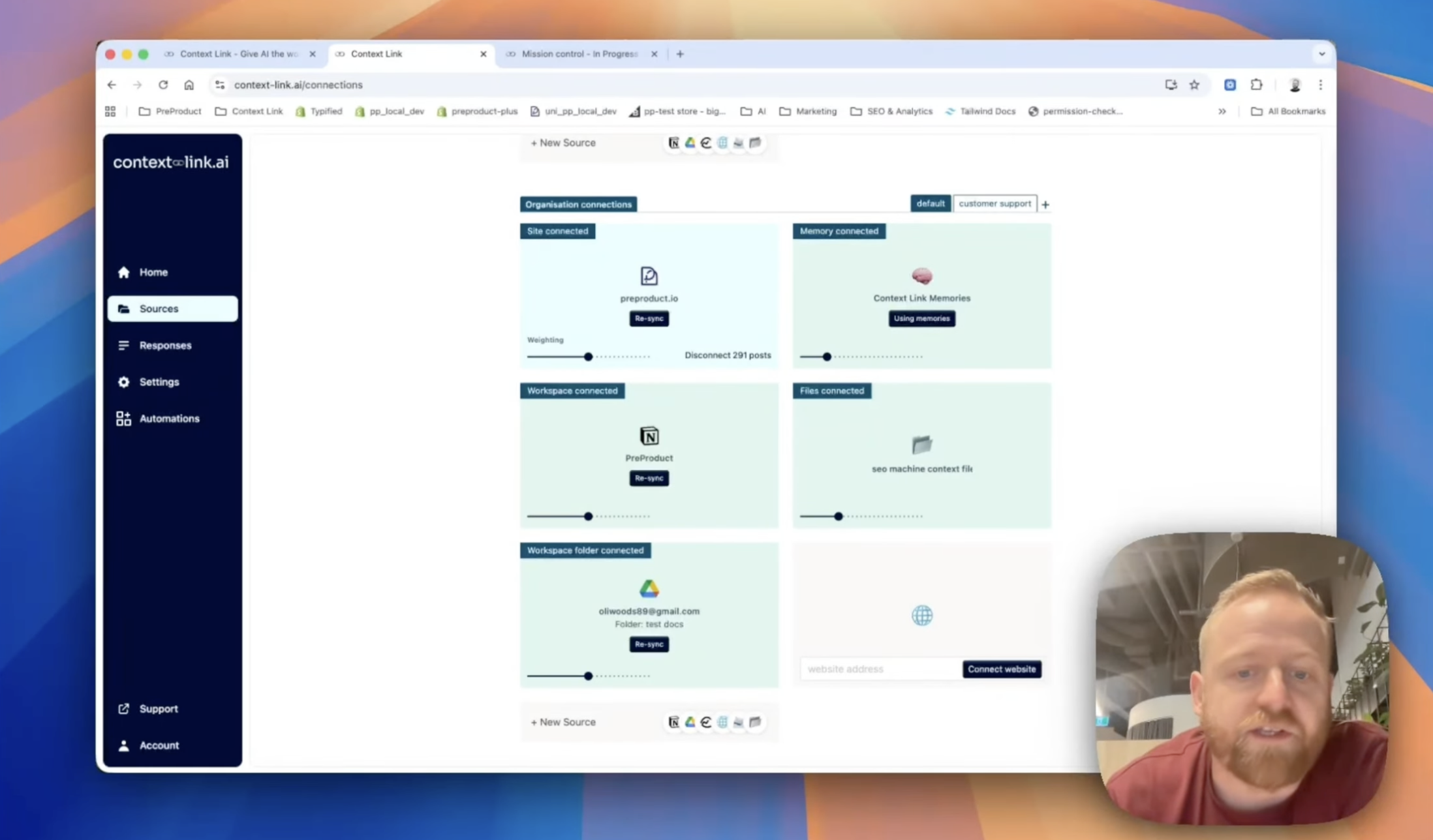
Modes re-weight your sources for each team and task
Create named profiles like 'support' or 'sales' that tune which sources Context Link leans on. A support Mode upweights your help centre and FAQs; a sales Mode upweights case studies and product specs. Same knowledge base, different lens.
09 / Across your team
Share context across your team
Stop pasting the same docs into every chat. Connect your sources once, and every teammate's AI pulls the latest context from the same place, consistently, with citations, every time.
Your team's AIs

ChatGPT

Claude

agent 004
session
One connected knowledge base


 +
+
+
+
+
+
Ready when you are
Ready to stop duct-taping context into prompts?
7-day free trial · start for free · cancel any time
FAQ
Frequently Asked Questions
What are context engineering tools?
Context engineering tools help you give AI the right information at the right time. Rather than pasting docs into prompts or hoping a model remembers your business, you connect your knowledge sources once and the tool retrieves relevant snippets on demand. Context Link is one such tool, built for small teams that want the benefits of a RAG pipeline without building one. Memories add a write path too: AI can save canonical knowledge back, and every connected tool reads the latest version.
How is this different from building my own RAG stack with Pinecone or Weaviate?
Rolling your own stack means chunking content, running embeddings, hosting a vector DB, and maintaining all of it. Context Link handles chunking, retrieval, formatting, and sync out of the box, behind a simple URL and set of skills. You trade some flexibility for something a marketing or support team can set up in minutes.
Building retrieval into your own product, for your customers?
Generating content or answering questions for your users, and want the output to pull from the full context of their business rather than a cleverer prompt? That is the point where a DIY stack gets expensive. Scraping each customer's site is slow and brittle, chunking is judgement calls, embeddings need re-running when content changes, the good result is weeks of tuning the scoring even with AI coding agents, and the vector database has to be hosted and kept isolated per tenant. The RAG White-Label plan does that work for you: one private vector index per end customer, built from their website (crawled, and chunked into searchable markdown) and/or the data you feed it from your own API calls, none of which you store or index yourself. Provision it over REST at signup, then read it with GET /api/v1/context (Get context, the matching passages for your own LLM) or GET /api/v1/question (Ask questions, one cited paragraph), server-to-server under your brand. $50/month per bundle of 10 customer accounts, no token fees on top, and no vector database or scoring algorithm to host. You build the UI. Start with the white-label RAG API page, then the docs.
What sources can I connect?
Google Docs and Drive, OneDrive, Notion, Basecamp, Monday.com, email inboxes and folders (Gmail, Outlook, Zoho, Fastmail, custom IMAP), any website via sitemap or URL list, and uploaded file stacks (PDFs, Word docs, Markdown). Memories are supported too, AI-saved namespaced notes for outputs you want to fetch back later. If your tool isn't in the catalogue, the custom-connections skill lets your AI fetch data from any service it can reach and push it into Context Link. If Claude can read it, you can push it to Context Link.
Does it work with Claude, ChatGPT, and other AI tools?
Yes. Context Link runs inside Claude (via skills), ChatGPT (via the app connector), Copilot, and Gemini (via direct link). One setup works across every model you use, so you're not locked into a single provider's plugin system.
How do teams share context without overlap?
Org accounts let admins connect company sources once, then every teammate accesses the same pool via their own account. Each person can also add personal connections that only they can see. Modes let you re-weight the same sources per use case, support prioritises help docs, sales prioritises case studies, without duplicating content.
Can I get a direct answer instead of raw snippets?
Yes. Alongside "get context on [topic]," you can invoke the Ask Question skill: /ask-question [question] or natural language like "ask Context Link what our refund policy is." Same retrieval under the hood, but a small fast LLM composes one grounded paragraph with numbered citations back to your sources. Available on Pro.