Works with ChatGPT, Claude, Gemini, and any MCP-aware agent
A hosted RAG MCP server for your business context
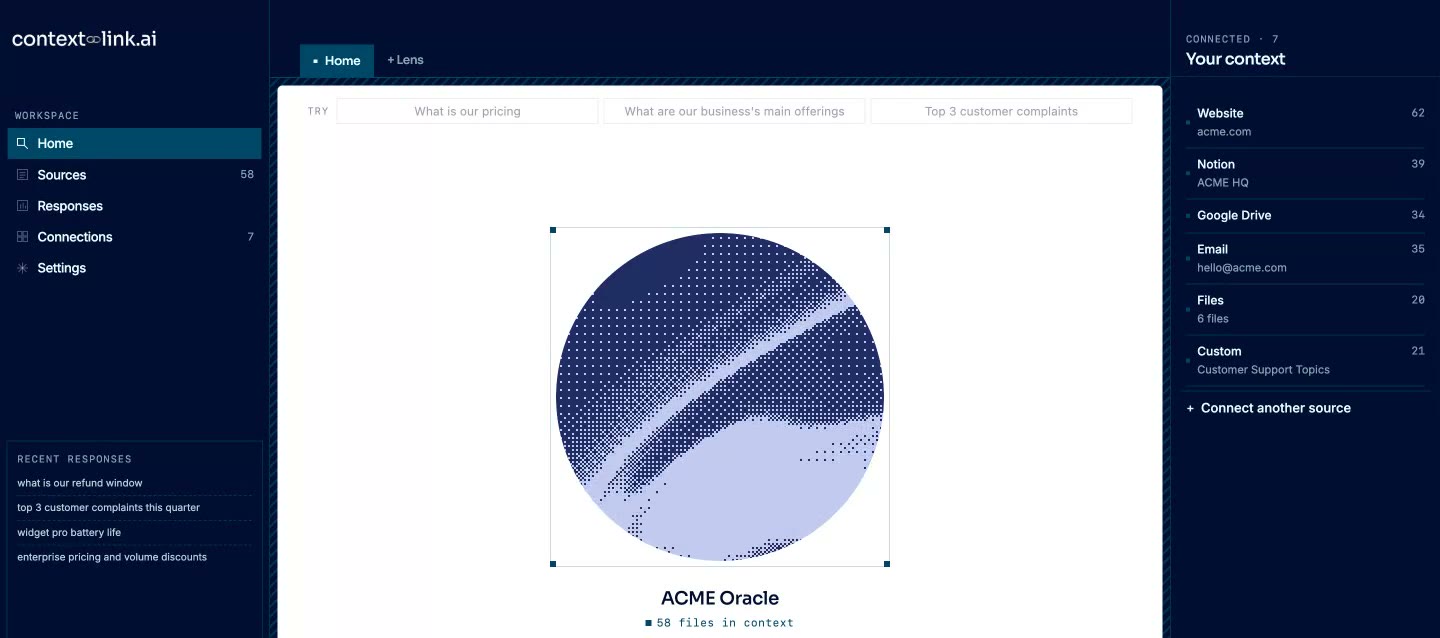
Connect your business sources once. Give any MCP-aware agent source-backed context from across your docs, sites, inboxes, files, and project tools.
7-day free trial · start for free · cancel any time
01 / Why Context Link

Skip the RAG
infrastructure
Context Link handles connectors, cleaning, chunking, embeddings, retrieval, and scheduled re-sync. Add one hosted MCP endpoint instead of maintaining a custom RAG pipeline.

Ground every agent
in business context
Any MCP-aware client can use the same four tools to search connected sources, get cited answers, and read or write Memories. Your agent gets useful context without bulk-loading your corpus.

Search every source
in one request
Search across Notion, Google Drive, OneDrive, Basecamp, Monday.com, websites, email, files, and custom connections together. Your agent does not need to guess which system holds the answer.
02 / Works with







 Basecamp


 Custom
 Websites
 Files
Files
 Email
Email
 Memory
*Don't see a pre-built connection? Download the custom-connections skill and Claude builds it for you. If Claude can read it, you can push it to Context Link.
03 / What it does
Connect the sources behind your RAG
Connect Notion, Google Docs, Google Drive, OneDrive, Basecamp, Monday.com, websites, email, and files. If a tool has no pre-built connector, the custom-connections skill lets your AI fetch it and push it in as markdown. Context Link cleans, chunks, and embeds everything into one vector-indexed knowledge base that syncs every 24 hours.
Give your agent four useful MCP tools
Point any compatible remote MCP client at the hosted Context Link server and sign in with OAuth. The agent can call get_context for source snippets, ask_question for a grounded answer with numbered citations, and save_memory or get_memory for reusable knowledge. Ask Question is available on Pro.
Retrieve only what the task needs
Context Link searches across every connected source by meaning and returns the most relevant, AI-friendly snippets with their sources. Your agent gets focused context instead of a bulk dump of the entire corpus. Use Modes to weight the same sources differently for support, sales, or another workflow.
Keep context current, cited, and reusable
Connected sources re-sync every 24 hours, so retrieval reflects the current version of your business knowledge. Responses remain traceable to their sources, and agents can save settled decisions as version-controlled Memories that every connected AI can retrieve later.
04 / In action
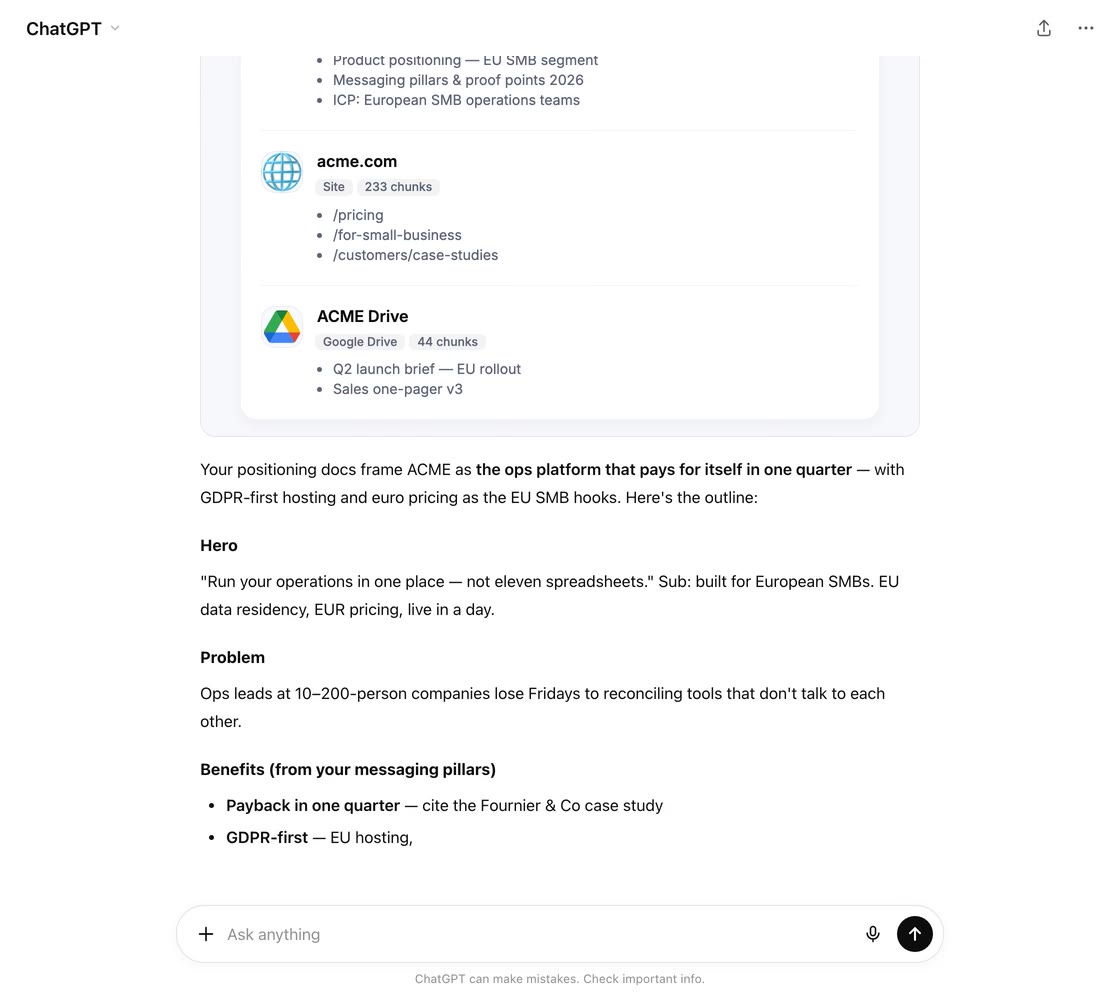
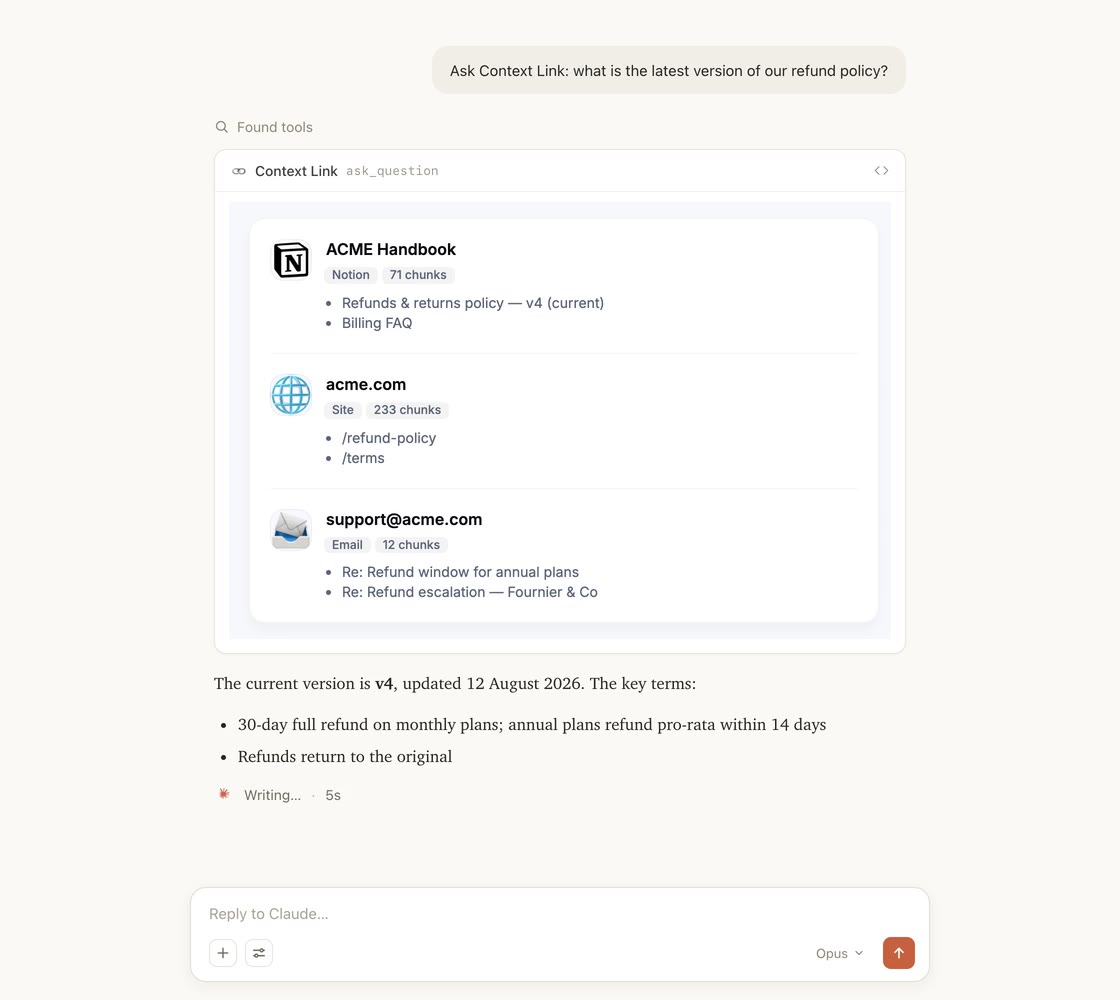
Integrates with the AI you already use
Available in every chat and project of the AI you already use. Complete with unified search across all your connections.
05 / Tools & skills
Skills your AI already knows how to call
Install once and your AI gets a vocabulary for your business: pull source-backed context, ask for a cited answer, or save a decision every other AI tool will read next time.
Tools & skills
Available in ChatGPT, Claude, Claude Code, and any MCP-aware agent.
Pulls source-backed context on a topic into the AI's working context.
When: “get context on…”
One concise answer with citations, grounded in your sources.
When: “ask my docs…”
Distills the conversation into a reference doc and saves it.
When: “save this as…”
Fetches a saved memory, merges in what's new, saves it back.
When: “update… with…”
The AI becomes the fetcher: pushes any service's data into your knowledge base.
When: building a custom source
06 / Industries
Context Link works with your kind of business.
Whatever you run, it probably lives in a variety of places. Connect them once, and Give AI a single way to talk to all of it.

Connect the support inbox, brand book, catalogue and help centre once, and AI gets a single place to ask your whole e-commerce business. From ChatGPT or Claude, ask what customers keep contacting support about, what you currently say about pricing, or how a product is described, and get source-backed answers instead of pasted-in context. When you settle something, like a returns policy or a brand rule, save it as a Memory so every AI tool reads the latest version.

Connect the docs you already keep, like specs, changelogs, interviews and support threads, and stop rebuilding that context in every AI tool. From inside ChatGPT or Claude, ask about your positioning, a past decision, or what users actually said in interviews, and get source-backed answers without knowing which doc holds them. Then save the canonical stuff, like your ICP or pricing rationale, as Memories that stay current as they change.
Connect your back-catalogue of briefs, case studies, brand books and project archives, and give AI one place to ask the whole studio. Ask anything and get source-backed answers grounded in your real history, so strategy stops half-remembering and starts citing, and every pitch stands on work you've actually done. Save the things you keep re-explaining, like your process or your point of view, as Memories any AI can pull into the next deck.

Your business lives in a variety of places, like docs, sites, inboxes and files. Connect them once and Context Link becomes the single place ChatGPT, Claude and agents can ask across all of it, returning source-backed answers without you guessing where the answer lives or pasting in background. Your business stops being something you re-explain to every AI tool, and becomes something they can simply talk to.
08 / Workflows
Workflow
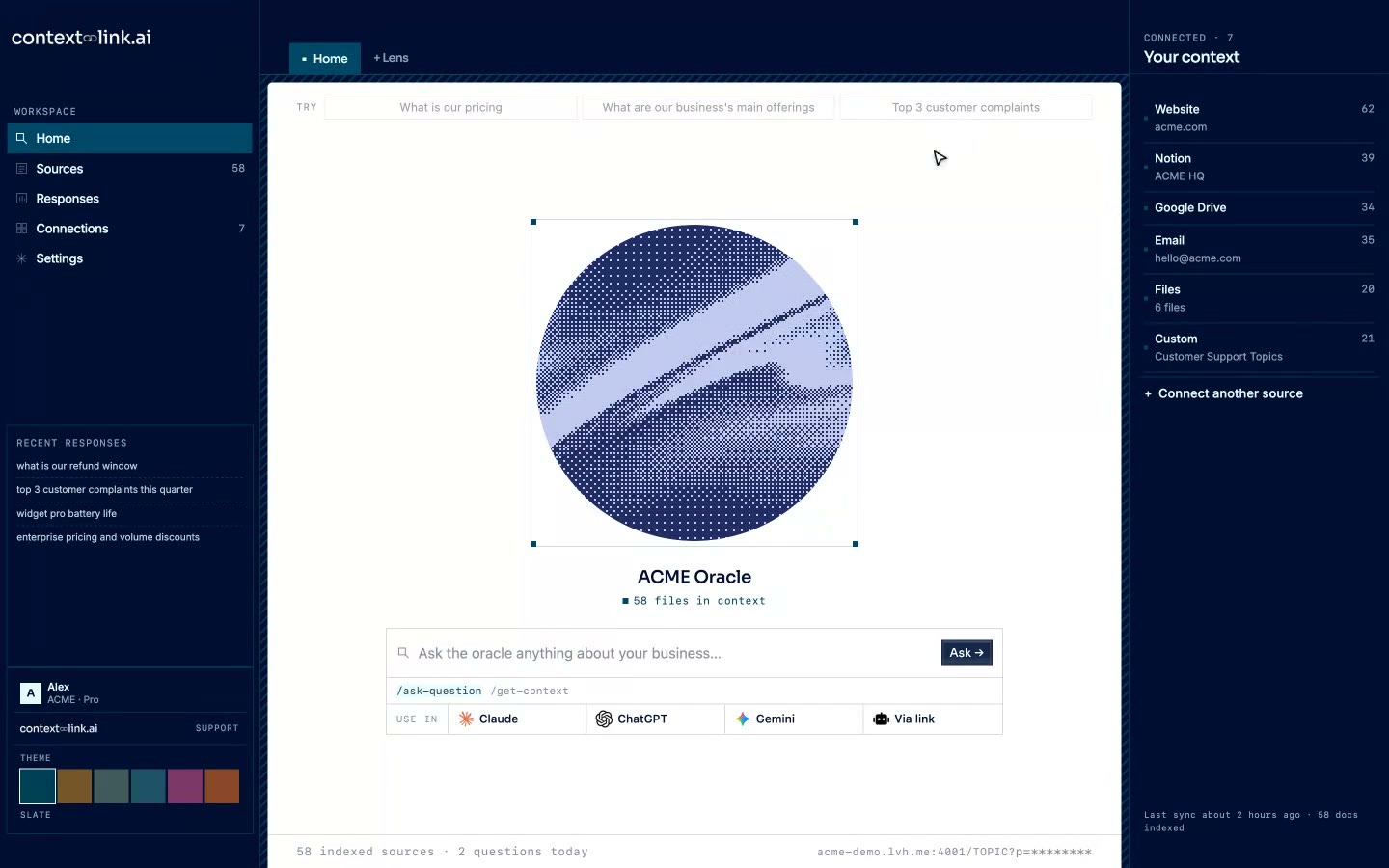
Call RAG from the agent you already use
Connect the hosted MCP endpoint once, complete the OAuth sign-in, and the four Context Link tools appear inside your client. Ask the agent to get context on a topic, retrieve a cited answer, or save a useful result without leaving its workflow.
Workflow
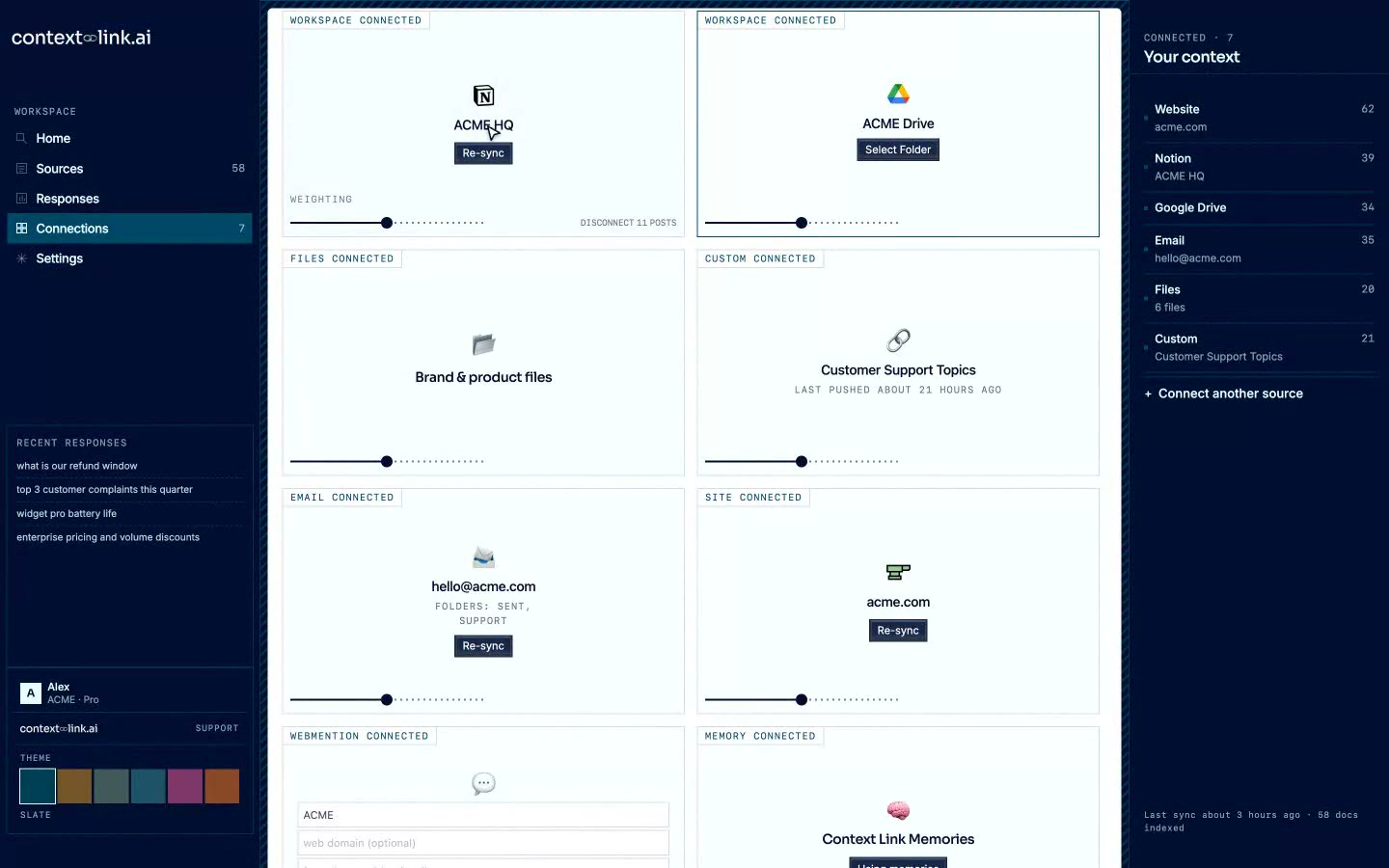
Control the RAG corpus source by source
Choose the Notion pages, Google Drive folders, websites, inboxes, project spaces, and files your agents can search. Add, exclude, disconnect, or re-sync sources whenever the boundary changes.
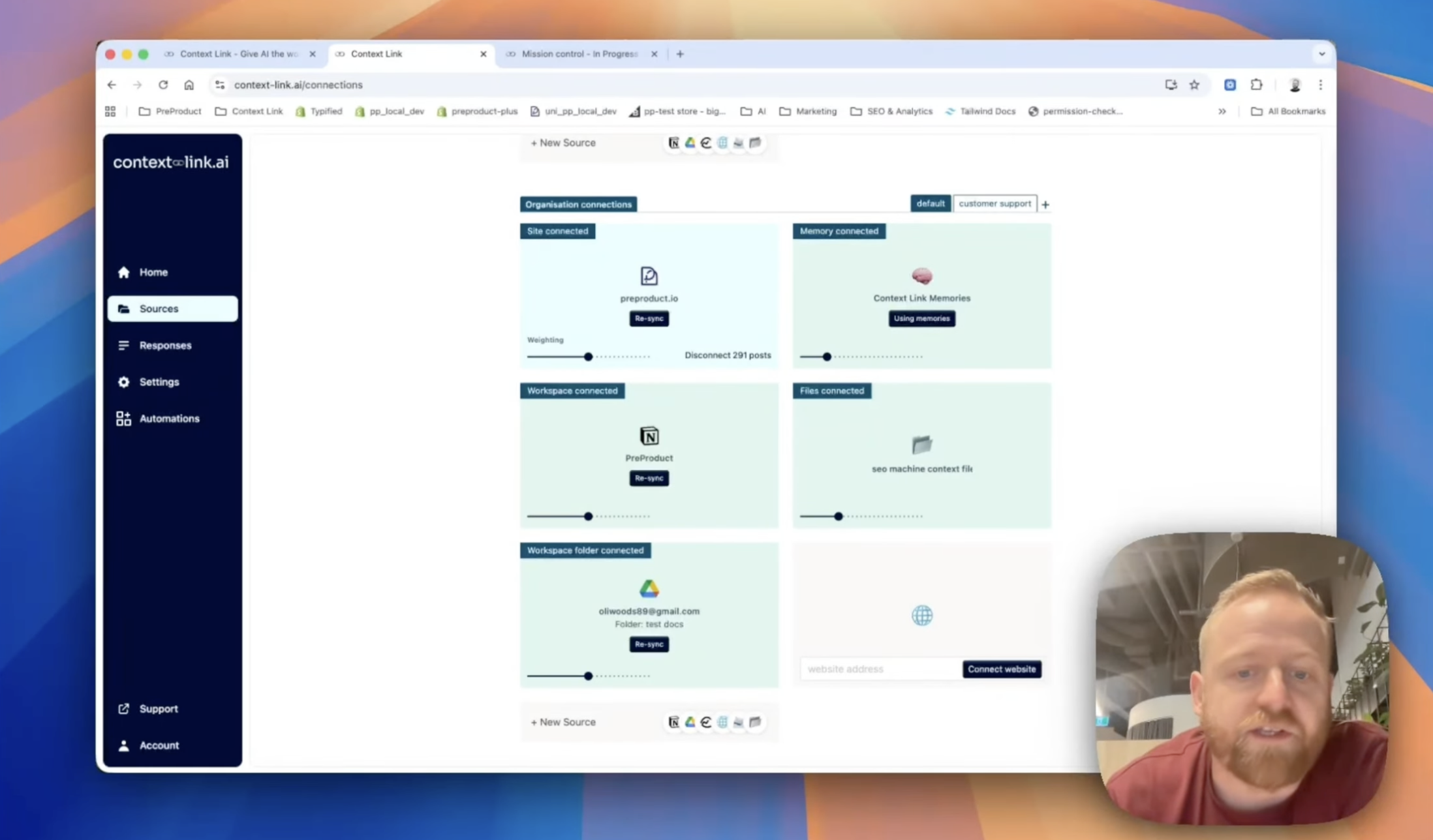
Tune retrieval per role
One context layer for different agent jobs
Create named Modes that change how sources are weighted for a task. A customer-support agent can favour help docs and FAQs, while a sales agent favours case studies and product material, without duplicating the knowledge base.
09 / Across your team
Share context across your team
Stop pasting the same docs into every chat. Connect your sources once, and every teammate's AI pulls the latest context from the same place, consistently, with citations, every time.
Your team's AIs

ChatGPT

Claude

agent 004
session
One connected knowledge base


 +
+
+
+
+
+
Ready when you are
Ready to give your agents a managed RAG layer over MCP?
7-day free trial · start for free · cancel any time
FAQ
Frequently Asked Questions
What is RAG MCP?
RAG MCP combines Retrieval-Augmented Generation (RAG) with the Model Context Protocol (MCP). RAG retrieves relevant material from a knowledge base before an AI answers, while MCP gives an AI client a standard way to call that retrieval system as a tool. Context Link packages both into a hosted server connected to your business sources.
How does a RAG MCP server work?
First, Context Link connects to your approved sources, cleans and chunks the content, creates embeddings, and stores it in a vector-indexed knowledge base. When an agent calls get_context, Context Link runs semantic search and returns the most relevant snippets with their sources. The agent can reason over those snippets, or use ask_question for a concise grounded answer with numbered citations on Pro.
Do I have to deploy my own RAG pipeline or MCP server?
No. Context Link hosts the MCP server at https://www.context-link.ai/mcp and handles source connectors, ingestion, chunking, embeddings, retrieval, citations, and scheduled re-sync. Add the server URL to a compatible client, sign in through OAuth, and use the tools from your existing agent workflow.
Which tools does the Context Link MCP server provide?
The server provides four tools: get_context searches connected sources, ask_question returns a grounded answer with numbered citations, save_memory writes reusable knowledge back to Context Link, and get_memory retrieves it later. ask_question requires Pro; the other three tools work on any active plan. See the MCP server setup guide for client-specific instructions.
Which MCP clients can connect?
Any client that supports remote MCP servers over Streamable HTTP can connect. This includes Claude Code, Cursor, VS Code with GitHub Copilot, Codex, and ChatGPT developer mode. Stdio-only clients can use an HTTP bridge, and Claude or ChatGPT users can choose Context Link's guided first-party integrations instead.
How is this different from building RAG with a vector database?
A vector database covers storage and similarity search, but you still need to build ingestion, connectors, chunking, re-sync, access controls, retrieval tools, and MCP transport around it. Context Link provides that managed layer and keeps it model-agnostic. Building your own stack gives you deeper infrastructure control; Context Link is for teams that want working business context without owning the pipeline.
Can an agent save knowledge back through MCP?
Yes. The save_memory tool lets an authorised agent save useful output as a named, version-controlled Memory, such as /pricing-rationale or /brand-voice. Other connected AI tools can retrieve the current version with get_memory, so settled knowledge does not need to be rebuilt in every workflow.
Can I use the RAG MCP server to give my own customers RAG inside my product?
Not over MCP. The hosted MCP server is for your own agents working on your own business context, and it is not something to expose to end customers. If you are a SaaS team who wants what your product writes or answers for each customer to pull from the full context of that customer's business, Context Link has a separate RAG White-Label plan: POST /api/v1/api_accounts provisions a private vector index per customer, built from their website (crawled, and chunked into searchable markdown) and/or the data you feed it from your own API calls, none of which you store or index yourself. GET /api/v1/context (Get context) or GET /api/v1/question (Ask questions) reads it back with that customer's token, server-to-server and under your brand. No token reaches a browser, and you build the UI. It is $50 a month per bundle of 10 customer accounts, with no usage fees on top and no vector database or scoring algorithm to host. Start with the white-label RAG API page, then the docs.